What Is AI-Powered Hiring in India
AI-powered hiring is not just resume parsing. Real AI hiring means verified skills, intelligent matching, and bias removal. Here is what it actually means and why most platforms claiming to do it are not.
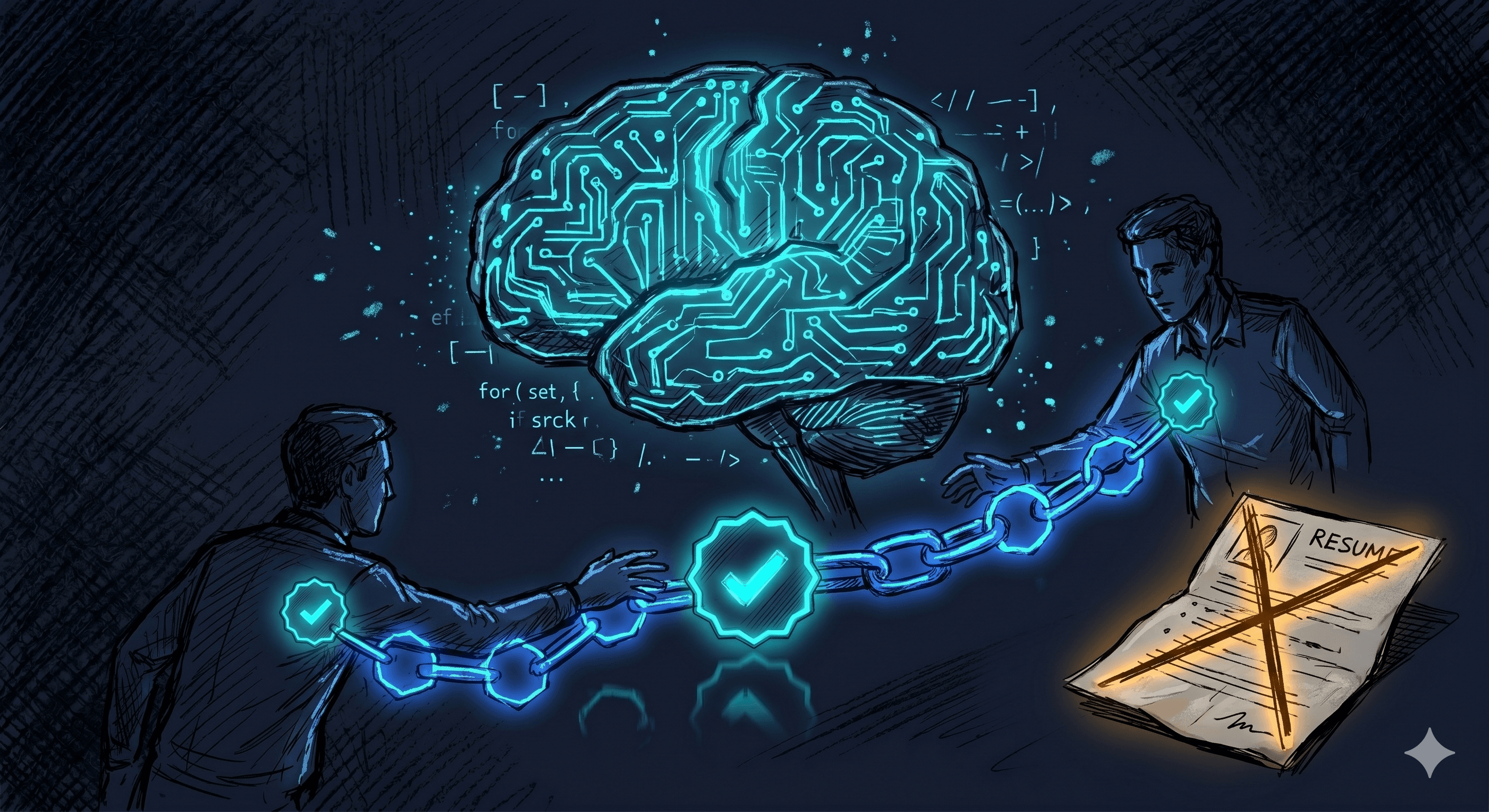
What AI-Powered Hiring Actually Means
AI-powered hiring has become one of the most overused phrases in Indian HR technology. Every ATS claims to use AI. Every job portal has an "AI matching" feature. Every screening tool markets itself as intelligent.
Almost none of them are doing what the label implies.
Real AI-powered hiring does three things: it verifies what candidates can actually do, it matches verified candidates to roles based on genuine skill alignment, and it removes the structural biases that cause Indian companies to consistently hire the wrong people.
Most platforms that claim AI hiring are doing only one of these, incompletely, at the resume layer. Resume parsing and keyword matching are not AI hiring. They are ATS with a new label.
This post explains what real AI-powered hiring is, why it matters for Indian companies in 2026, and what to look for when evaluating any platform that makes this claim.
The Problem AI Hiring Is Trying to Solve
Traditional hiring in India is broken at the input layer. The resume is the primary input, and the resume is a deeply unreliable document.
Candidates inflate job titles. They claim credit for team work. They list skills they learned at a surface level but cannot apply under real conditions. They present projects they copied from tutorials as original work. None of this is new, and none of it is unique to India, but the scale of competition in the Indian developer market makes the inflation worse because the stakes of filtering are higher.
On the employer side, the volume of applications is unmanageable without automation. A single developer role at a funded Indian startup can attract 500 to 2,000 applications. No hiring manager can evaluate these manually. So companies use ATS filters, keyword matching, and resume screening tools to reduce the pile.
The problem is that these filters have no relationship to actual job performance. They filter for certain college names, certain company names, certain keyword combinations. They filter out candidates who are not good at writing resumes, not because those candidates cannot do the job.
AI hiring is supposed to fix this by shifting the input from what candidates say about themselves to what candidates can actually demonstrate.
What AI Hiring Is Not
Before defining what it is, it helps to be clear about what it is not.
Resume parsing is not AI hiring. Extracting structured data from a resume document using machine learning is a solved technical problem from the 2010s. It is useful for ATS workflows but it does not make the hiring process more accurate. It just makes the same broken input faster to process.
Keyword-based job matching is not AI hiring. Matching a candidate to a job because both contain the word "Python" is not intelligent. It tells you nothing about whether the candidate can actually build what the role requires.
Automated scheduling and chatbots are not AI hiring. These are useful operations tools. They reduce recruiter time on logistics. They do not improve the quality of hiring decisions.
Resume ranking with a score is not AI hiring. If the ranking is based on resume content, it inherits all the flaws of the resume. A higher score on a better-written but inaccurate resume does not make the candidate more qualified.
What Real AI-Powered Hiring Does
Real AI-powered hiring intervenes at the skill verification layer, not the resume layer.
Skill verification. AI-graded assessments that test what a candidate can actually do in realistic scenarios. Not multiple choice. Not theoretical questions. Actual coding tasks, debugging exercises, system design problems, or domain-specific scenarios that require applied knowledge to complete. The AI evaluates the quality of the approach, not just whether the output is correct.
Proctored assessment integrity. AI monitoring during assessments to ensure the results are honest. Eye tracking, tab switch detection, copy-paste pattern analysis. Without integrity monitoring, assessments are just open-book tests and the scores are meaningless.
Intelligent matching based on verified signals. Once skill tiers are verified, matching candidates to roles based on actual demonstrated ability rather than resume keywords. A company looking for a Silver-tier React developer sees candidates who have passed a React assessment at that level. The match is grounded in verified skill, not self-reported experience.
Bias reduction through standardised evaluation. When every candidate is evaluated on the same tasks with the same AI grading criteria, the evaluation is not influenced by college name, interviewer mood, candidate appearance, or communication style. The score reflects what was demonstrated, not who the candidate is or where they studied.
Why This Matters Specifically in India
Indian hiring has two structural problems that AI-powered hiring is well-positioned to solve.
The first is credential inflation. India produces approximately 1.5 million engineering graduates per year. A significant number of them enter the job market with degrees from institutions that do not produce industry-ready developers. The degree exists but the skills do not. At the same time, many developers without formal degrees or from lesser-known institutions have genuine skills they cannot credibly signal. The resume cannot distinguish between these two groups. Verified assessments can.
The second is the bias toward pedigree. Hiring at Indian tech companies skews heavily toward graduates of IITs, NITs, and a small number of branded private institutions. This is not a conscious bias in most cases. It is a pattern that emerged because these institutions were reliable proxies for quality when no other verification existed. Verified skill data makes this proxy unnecessary. A developer from a tier-3 college who passes a Gold-tier assessment is more qualified for the role than an IIT graduate who cannot pass Silver.
How Proovn Implements AI-Powered Hiring
Proovn is built around verified skill tiers, not resume profiles.
Developers on Proovn take proctored AI-graded assessments in their skill area. The assessments are realistic: code writing tasks, debugging scenarios, and applied problem solving. AI grades the quality of the approach, identifies reasoning patterns, and assigns a verified tier.
Bronze means solid fundamentals and reliable execution on standard tasks. Silver means production-ready skills and independent problem solving. Gold means senior-level judgment, system-level thinking, and the ability to own a technical area.
These tiers are verified and public. Employers on Proovn search by skill and tier. They see candidates whose ability has been independently confirmed. They can contact verified candidates directly without running a resume screen or a first-round technical assessment.
The result is faster hiring with higher signal. Employers stop interviewing candidates who looked good on paper but could not perform. Developers stop losing opportunities to resume filters they never had a chance to beat.
What to Look for in Any AI Hiring Platform
If you are evaluating AI hiring tools for your company, ask three questions.
Does it verify skills through actual tasks, or does it process what candidates say about themselves? Any platform that relies primarily on resume content is not doing AI hiring. It is doing faster ATS.
Does it have integrity monitoring? Unproctored skill assessments are worthless. Candidates will use every available resource to game them. If there is no monitoring, the scores are not reliable.
Does the matching use verified signals or inferred signals? Matching based on verified assessment results is meaningfully different from matching based on resume keywords or self-reported years of experience.
Most platforms that claim AI hiring fail at least two of these three.
Bottom Line
AI-powered hiring is a meaningful shift in how companies can find qualified developers, but only when it is built on skill verification, not resume processing.
In India in 2026, the difference between a real AI hiring platform and a rebranded ATS is the difference between hiring developers who can do the work and hiring developers who are good at looking like they can.
Post your developer role on Proovn and see what verified hiring actually looks like.
Ready to hire verified developers?
Post a job and get AI-matched with skill-tested developers in minutes.
Get started free →